
3 Ways to Boost Iron
“ It’s not just how much iron you take — it’s how well your body absorbs it.”
Why “Normal” Iron Levels Still Left Me Exhausted (And What Finally Helped)
For years, I was told the same thing:
“Your iron levels are normal.”
“You’re perfectly healthy.”
And yet… I didn’t feel healthy.
I was silently experiencing a lot of the symptoms that align with low ferritin:
Constant fatigue (even after a full night’s sleep)
Hair thinning and shedding
Brain fog and poor focus
Feeling cold all the time
Dizziness and frequent headaches
Shortness of breath with exercise
Restless legs at night
If you’ve ever been here, you know.
When “normal” becomes your normal
What I’ve learned through this journey is this:
How you FEEL matters even more than what the numbers say.
But here’s the problem…
When you’re repeatedly told your labs are “normal,” you start to normalize how you feel.
You push through the fatigue.
You accept the brain fog.
You tell yourself maybe this is just part of being busy, or getting older, or being a mom.
And slowly, you stop questioning it.
So how do we advocate for ourselves when we’re tired of feeling tired… and being told we’re fine?
My ferritin story
Looking back at my labs over the years, my ferritin levels were always:
Low
Often below even conventional “normal”
Or just barely scraping the bottom of the range
But never flagged as a problem.
It wasn’t until I started working with a naturopath (initially to support my hormone health) that things really started to click.
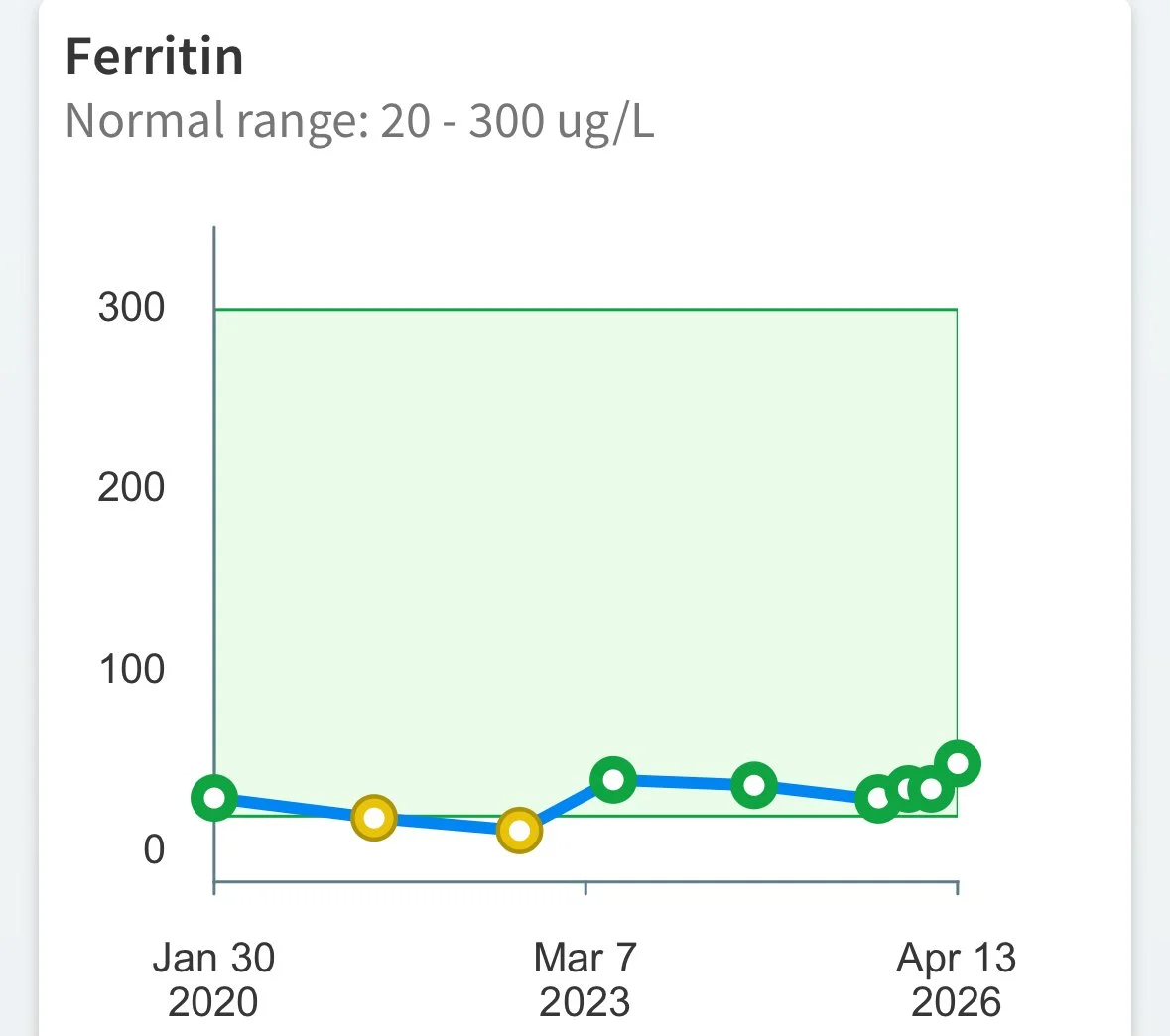
My Ferritin levels over the past 6 years.
The missing piece: gut health & absorption
What I discovered was surprising—but also made complete sense.
My gut was inflamed, with:
Bacterial overgrowth
Candida overgrowth
This inflammation was directly impacting my body’s ability to absorb nutrients… including iron.
And this is something that’s well-supported in research.For example, this review highlights how inflammation and gut health significantly impact iron absorption:https://pmc.ncbi.nlm.nih.gov/articles/PMC9219084/
So it wasn’t just about taking more iron…It was about actually absorbing it.
The shift (and what changed for me)
Once I started addressing my gut health and supporting absorption, things started to shift.
That small bump at the end of my ferritin chart?
It was actually a more than doubling of my ferritin levels:
👉 From 23 → 49
And that was with just a few intentional changes to my daily routine.
Not perfection.
Not extremes.
Just aligned, supportive habits.
If you’ve been feeling exhausted, foggy, or just not like yourself, there’s likely an explanation for it. As a hormone health coach, I talk a lot about how hormone optimization can help you feel better, but sometimes there’s more to the story.
And here’s the part most people don’t realize…
👉 It’s not just how much iron you take — it’s how well your body absorbs it.
Let’s break it down simply 👇
⚡ Common signs your iron may be low
Constant fatigue (even after sleep)
Hair thinning or shedding
Brain fog or poor focus
Feeling cold all the time
Dizziness or headaches
Shortness of breath with exercise
Restless legs at night
Many women are told their labs are “normal”…
but still feel these symptoms every day.
🧠 What your ferritin level really means
Ferritin reflects your iron stores.
Conventional “normal”: ~20–300 µg/L
Functional optimal: ~75–100 µg/L
👉 Why the difference? Functional medicine seeks to PREVENT symptoms of deficiency - such as fatigue, hair loss, and brain fog - whereas convention medicine is focused on avoiding disease (in this case anemia) and preventing overload conditions like hemochromatosis (Learn more about the Ferritin Test at Cleveland Clinic).
🔑 3 ways to boost iron absorption
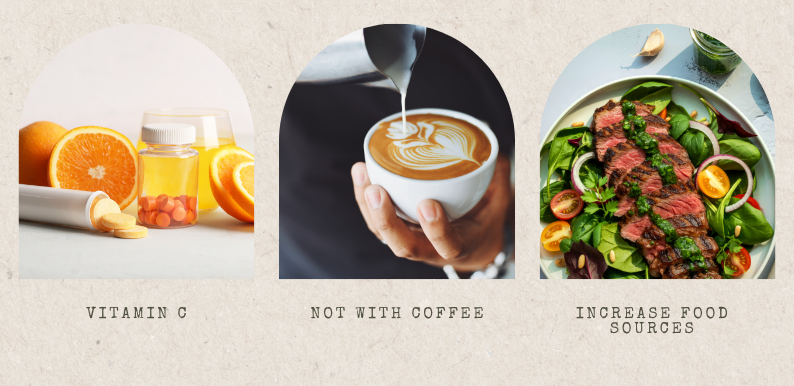
These are the exact strategies I’ve personally implemented—and now share with clients:
1. Pair iron with vitamin C
Vitamin C helps convert iron into a form your body can absorb more efficiently.
This can be as simple as:
Adding lemon to meals
Eating berries alongside iron-rich foods
Or using a supplement that already includes vitamin C
Research consistently shows vitamin C enhances iron absorption and improves ferritin levels:https://cdhf.ca/en/iron-absorption-understanding-factors-that-enhance-or-inhibit-uptake/
Research also confirms vitamin C can improve iron-related outcomes like ferritin levels when combined with supplementation: Efficacy of Vitamin C with Iron Supplementation
✨ Try: I have been personally using this option from SHAKLEE
2. Avoid common “iron blockers”
This was a big one for me.
Certain things can significantly reduce how much iron your body absorbs:
Coffee & tea
Calcium
Dairy
Magnesium (high doses)
👉 Now, I simply space these 1–2 hours away from iron-rich meals or supplements—and it makes a difference.
3. Focus on absorbable forms of iron
If your gut is inflamed, you can be doing everything right… and still not absorbing iron properly.
For me, this looked like working with a naturopath and:
Addressing bacterial and candida overgrowth
Reducing inflammation
Supporting digestion and absorption
This is where things truly started to shift—not just in my labs, but in how I actually felt.
Not all iron supplements are created equal.
Heme iron (animal sources) → best absorbed
Non-heme iron → needs support (like vitamin C)
Also:
Take iron on an empty stomach if tolerated
Or with a small meal (without blockers)
💬 Final thoughts
If I’m being completely honest…
It’s just nice to finally feel validated.
To feel heard.
To understand what’s actually going on in my body.
And to know that I wasn’t “fine”—I was just being overlooked.
If you’re in this place right now…
If you’ve been told your labs are normal, but you don’t feel like yourself…
Please don’t ignore that.
Your symptoms are real.
Your body is communicating with you.
And you deserve answers that go deeper than “you’re fine.”
If this resonates with you, I’d love to support you in your hormone and health journey.
This is exactly why I do what I do 💛
✨ If you want help interpreting your labs or creating a personalized plan, tap the button below — I’d love to support you. ✨
* Disclaimer: This post is for educational purposes only. Certain medical conditions require more in depth consultation and specialized care which is beyond the suggestions I am offering in this post. Please seek the advice of your primary health care provider prior to starting any supplementation.